
RajaRak App is an internal admin tool built for Raja Rak Indonesia’s marketing team, routing WhatsApp inquiries from across the company’s growing network of business websites to available marketing staff on a fair, round-robin basis, backed by a full analytics dashboard to track where every click comes from.
A scrollable look at the finished site, exactly as a visitor would browse it.
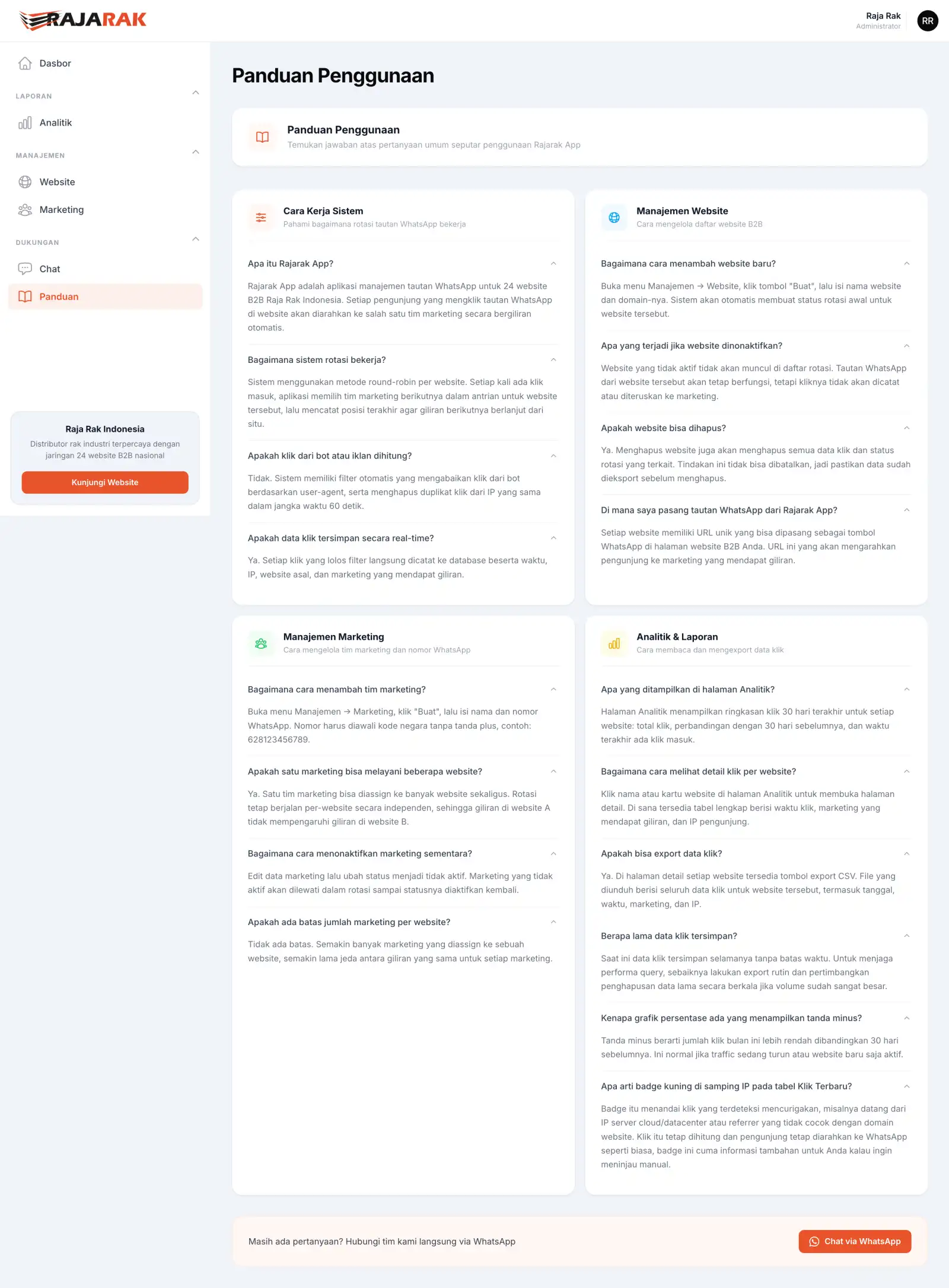
Desktop
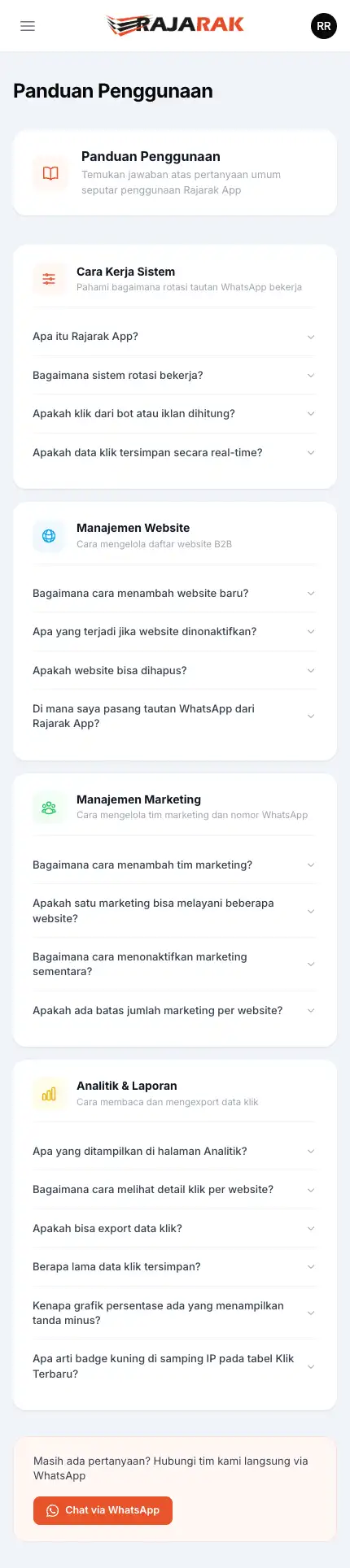
Mobile
Work like this is usually split between a developer, a UI/UX designer, a graphic designer, and a marketer. On this project, one person holds all four of those skill sets, so every decision came from someone who understood the whole project, not just their own part of it.
16
standards met, from code to marketing.
Business impact here is measured across 4 areas: Presence, Quality, Conversion and Growth. Together they cover how the business is found, perceived, and acted on.
Clean, trustworthy performance data
Before
There was no way to see which website or marketing contact was actually generating engagement, and automated bot traffic could inflate click numbers, making some websites or contacts look more effective than they really were.
After
A full analytics dashboard now tracks click trends and performance by website and marketing contact, with automated filtering keeping bot traffic out so every number reflects real customer interest.
Each project draws on a mix of disciplines: here’s how they came together on this one.
The tools and technologies that came together to bring this project to life.










The problems that came up while building this project, and what came out of solving them.
Keeping Redirects Fair and Consistent
Rotating WhatsApp leads fairly across the marketing team, while making sure a customer who reloads the page always lands on the same contact, required careful state management with database-level locking to stay safe under concurrent traffic.
Keeping Click Analytics Clean
Bot traffic, uptime monitors, and automated crawlers could easily pollute analytics with fake clicks, solved with layered filtering that keeps the dashboard’s numbers trustworthy without needing manual cleanup.
Serving Many Websites From One System
Each of the company’s business websites needed its own redirect link, message template, and rotation pool, all managed from a single admin panel instead of duplicating logic per site.
The technical problems fixed while building this project.
Analytics data kept clean of bot traffic
Images under 200KB
Consistent redirects under load
Built for continuous data growth
Isolated, testable logic
Before
Automated bot traffic, crawlers, and uptime monitors hitting the redirect endpoint could inflate click counts and pollute every analytics number, with no way to separate real customer clicks from automated noise.
After
Bot and crawler detection through user-agent and traffic-pattern analysis, combined with rate limiting against automated abuse, filters this traffic out before it ever reaches the analytics data.
Before
High-resolution images across the site, not just one section, risked slowing down every page.
After
Every image across the site is compressed to WebP and kept under 200KB, keeping pages fast without a visible drop in quality.
Before
Simultaneous clicks arriving from many websites at once risked race conditions when picking the next marketing contact, or a slow redirect under load.
After
Database-level locking keeps rotation selection fast and consistent even under concurrent traffic, with redirects staying near-instant.
Before
A click log that grows continuously from real-time traffic across many websites risked slowing down over time without the right query patterns and indexes.
After
Query patterns and indexes were planned upfront for a table that keeps growing, keeping analytics queries fast as data accumulates.
Before
Rotation and click-filtering logic mixed directly into models or controllers would be difficult to test in isolation and reuse elsewhere.
After
A dedicated service layer keeps this logic clean, testable, and reusable, verified with automated tests.
